

IELTSGO: Private, Local-First IELTS Preparation for All Four Skills
Courses & CertificationsDescription
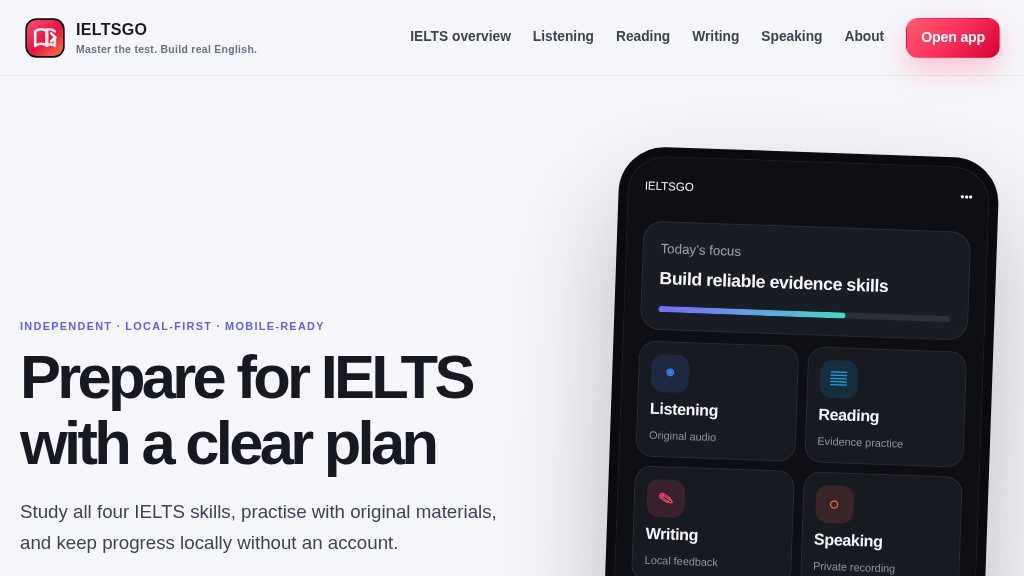
Study all four IELTS skills, practise with original materials, and keep progress locally without an account.
The Main Idea
Preparing for IELTS often involves juggling separate resources for listening, reading, writing, speaking, vocabulary, timing, and progress tracking. IELTSGO appears designed to bring that workflow into one browser-based study system while avoiding the need for a learner account. Its central approach is local-first: attempts, drafts, recordings, vocabulary, and study history are kept in the browser through IndexedDB rather than tied to a visible online profile.
The platform covers both Academic and General Training pathways. Visitors can choose a test type, target band, and daily goal to create an editable local study plan, then move through lessons, deliberate practice, review, and timed simulations.
What Visitors Can Explore
The site presents a four-skill path with original practice content, explanations, timers, transcripts, evidence-focused exercises, and weak-area tagging. Listening includes original audio, while speaking practice supports private local recordings with deletion controls. Writing work can be saved as autosaved drafts and reviewed with deterministic checks, self-assessment rubrics, and an optional AI enhancement that is explicitly disclosed.
Practice is organized into learning mode, targeted retry, sectional tests, mini mocks, and full mocks. The excerpt also indicates resume support and realistic timing, which may help learners build a repeatable exam routine rather than rely only on isolated questions.
Strengths
- Covers Academic and General Training preparation across all four IELTS skills
- Keeps progress, drafts, recordings, and study history locally without requiring a learner account
- Combines lessons, targeted practice, vocabulary review, and timed mock formats
- Offers mobile-first PWA access with supported offline downloads and local data export/import
Cons
- Local browser storage makes backup and data portability details important to verify
- Feedback is described through deterministic checks, rubrics, and optional AI rather than confirmed human examiner marking
- The supplied evidence does not establish live tutoring, cloud synchronization, or conversation practice
Potential Uses
IELTSGO could suit someone who wants a structured daily plan without registering for a learner account. It may also be useful for learners who prefer studying on a phone, since the site is described as mobile-first and installable as a PWA. Supported lessons, question banks, and listening audio can be explicitly downloaded for offline-ready use, although visitors should confirm which materials are available offline on their device.
Local export and import may be useful when moving study data or preserving progress, while spaced-repetition vocabulary and weak-area labels provide practical ways to guide revision.
Audience and Fit
This looks most relevant to independent IELTS candidates who are comfortable combining automated checks with self-assessment. Privacy-conscious learners may appreciate local recordings and the absence of a required account. It may be less suitable for anyone seeking confirmed teacher marking, live conversation practice, or a fully cloud-synchronized profile; none of those services is evidenced in the supplied material.
Before You Rely on It
The local-first design reduces account dependence, but it also makes browser and device management important. Visitors should verify how export/import works, what happens when browser storage is cleared, and the exact scope of offline access. Writing feedback should be treated as practice guidance rather than a substitute for an official examiner’s assessment.
Overall, IELTSGO presents a coherent, privacy-oriented IELTS routine with broad skill coverage and useful local study controls. Its strongest fit is self-directed practice; the main trade-off is that independent learners must manage their own backup and feedback expectations.
Embeds
Copy short script widgets for this listing. People often use Textfrog to search for their next personal or work tool. Encourage your community to leave reviews on Textfrog.
Review widget
A clean review badge with stars and review count.
Featured badge
A compact badge for products listed on Textfrog.
Similar Tools
Tech U is a modern learning platform offering industry-focused technology course...
GoLogica offers an online artificial intelligence master’s program with practi...
Eduify is an online education platform that provides tools and resources for lea...
Free online courses with certificates. Join 15 million graduates and empower you...
Featured Links
Eduify is an online education platform that provides tools and resources for lea...