
Precision AI OS: AI Agents and Workflow Automation for Service Firms
Ai Agents & AutomationDescription
Build an AI data pipeline, firm OS and agents around your business. with practical details.
Why It Stands Out
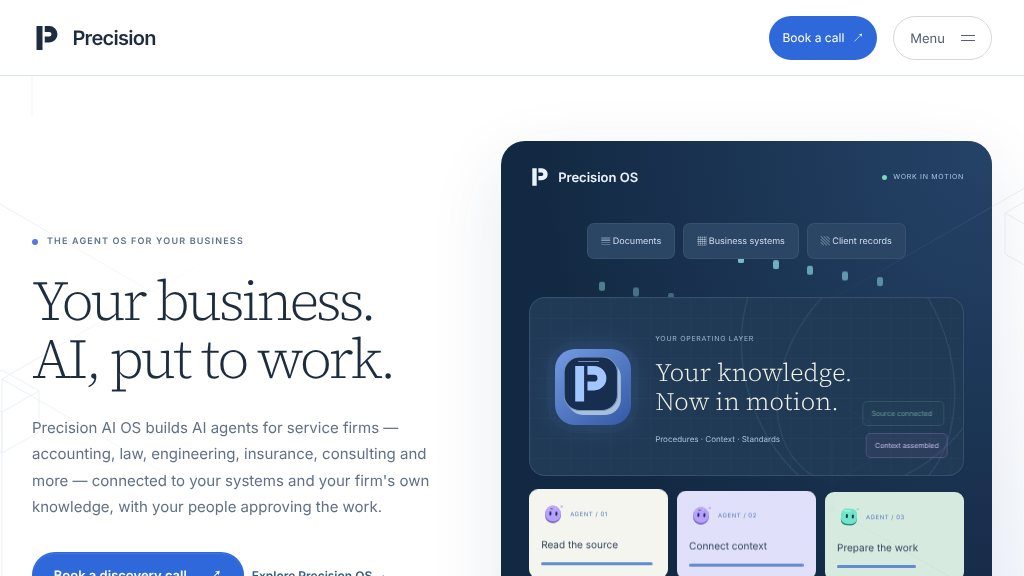
Many service firms already have the information needed to prepare client work, answer requests, and check records—but that information is spread across business systems, documents, client files, and internal procedures. Precision AI OS appears designed for this gap: it brings those sources together, assembles relevant context, and prepares work for human review rather than presenting automation as a replacement for professional judgment.
The platform is positioned as an operating layer for service businesses such as accounting, law, engineering, insurance, and consulting. Its model combines an AI data pipeline, a firm knowledge foundation, and a coordinated set of agents that work within defined permissions and review points.
How It Can Be Used
The visible examples focus on preparation-heavy workflows. Agents can gather source records, organize business context, produce a working draft, and surface questions or exceptions for a team member to evaluate. The examples are illustrative rather than evidence of a particular customer implementation, but they show the intended pattern clearly:
- Accounting and tax teams may use it to bring together client files and source records for review preparation.
- Architecture and engineering firms may apply it to project status, RFIs, submittals, or invoicing packs.
- Insurance agencies and brokers may organize service inboxes, renewal files, and certificate requests.
The underlying approach is less about a single chatbot and more about coordinating specialized agents around existing work. Approved procedures, past work, standards, and business context are described as inputs to the system, while people remain responsible for reviewing and deciding.
Strengths
- Combines an AI data pipeline, firm knowledge layer, and coordinated agents around service-firm workflows.
- Keeps people involved through permissions, prepared outputs, source references, and review points.
- Addresses concrete preparation tasks across accounting, engineering, insurance, and other professional services.
- Describes data isolation, model-call controls, document processing, and recorded approvals.
Cons
- The supplied material does not include public pricing, customer results, or detailed integration lists.
- The discovery-led approach may require substantial configuration and implementation support.
- Industry examples are illustrative, so workflow fit and performance should be verified directly.
Important Details to Check
The website describes firm-level data isolation, unique encryption keys, zero-retention and no-training terms for language-model calls, and document reading through Google Cloud Document AI. It also states that approvals and model calls are recorded. These are meaningful design claims, but organizations handling sensitive client information should verify the contractual terms, deployment details, retention settings, access controls, and compliance coverage directly.
No public pricing, self-serve signup path, customer case studies, or quantified productivity results are provided in the supplied material. The stated starting point is a discovery process that maps a firm's work and data before a first workflow is built, suggesting that implementation may require consulting and configuration rather than a simple plug-in setup.
Possible Fit and Evaluation Notes
This may suit professional-service firms looking to improve repetitive preparation across multiple systems while keeping approval with their staff. It is less obviously suited to someone seeking a general-purpose consumer assistant or an immediately deployable automation template.
A sensible evaluation would begin with one bounded workflow, clear source records, and measurable review effort. Visitors should ask which systems can be connected, how agents are scoped, how exceptions are handled, what audit information is available, and how ongoing maintenance is managed. The strongest evidence will come from a workflow-specific demonstration using the firm’s operating requirements—not from broad claims about AI in general.
Embeds
Copy short script widgets for this listing. People often use Textfrog to search for their next personal or work tool. Encourage your community to leave reviews on Textfrog.
Review widget
A clean review badge with stars and review count.
Featured badge
A compact badge for products listed on Textfrog.
Similar Tools
JONI is your personal AI computer. with practical details for online visitors.
See.io offers useful online resources, features, and information for visitors ex...
Build, test, deploy, and monitor production-ready AI voice agents at scale with ...
OpenCode - The open source coding agent.
Featured Links
Setvo: your workouts, your progress, your space. with practical details for onli...
Eduify is an online education platform that provides tools and resources for lea...