WheelMigo
WheelMigo: Free Random Name and Choice Spinner with No-Repeat Rounds

Family immigration to the United States: reunification with spouse, children, parents, siblings. With practical details.
Added November 8, 2026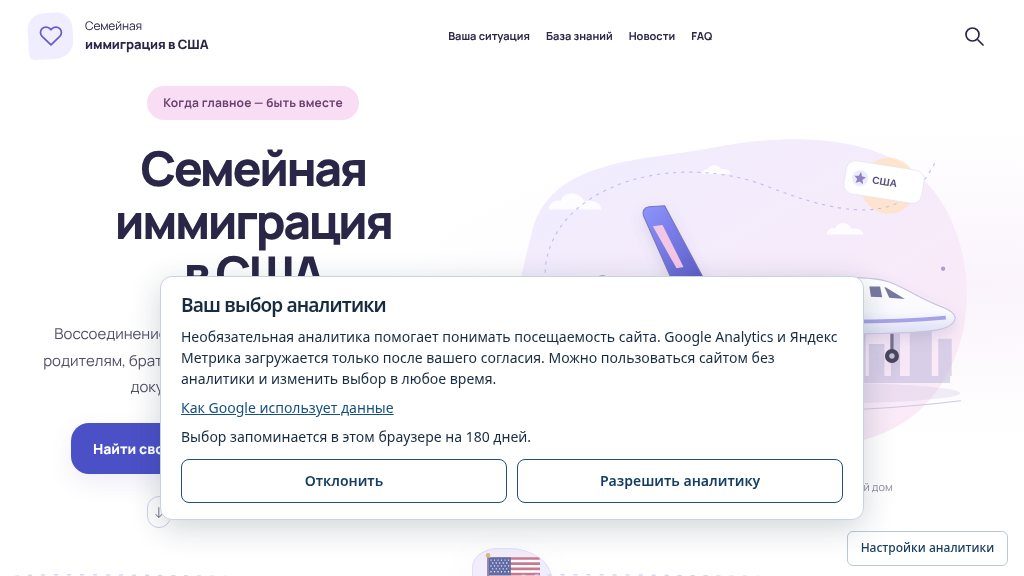
Someone trying to bring a spouse, child, parent, sibling, or fiancé(e) to the United States may arrive here looking for a practical starting point. The website is a Russian-language information resource focused on family-based immigration and reunification. Rather than presenting one universal route, it frames the process around two questions: the family relationship and the U.S. sponsor’s status as either a citizen or a lawful permanent resident.
The material is informational rather than a promise of approval, a visa, or a particular processing time. Visitors should treat it as a research and planning resource, then confirm case-specific requirements through official sources or a qualified professional.
The homepage directs visitors through a situation-based pathway. They can select a relationship—such as spouse, child, parent, sibling, or fiancé(e)—and then compare the implications of the sponsor’s status. This is a useful structure because eligibility is not determined by family connection alone. The site also separates broad stages of the process:
Identifying the relevant family category
Preparing a petition and supporting evidence
Addressing financial sponsorship
Following a consular or adjustment-of-status route
Monitoring visa availability and age-related issues
A searchable knowledge base, question-and-answer section, news area, and longer guides provide additional ways to explore the subject.
The visible content references common forms and stages, including Form I-130, I-130A, NVC processing, DS-260, interviews, I-485, and Form I-864. It also covers evidence of family relationships, translations, bona fide marriage documentation, domicile, joint sponsors, assets, Visa Bulletin categories, and the Child Status Protection Act (CSPA).
The site gives particular attention to situations that often require careful review, including divorce, changes in citizenship, age-out concerns, and VAWA-related family violence cases. Its FAQ examples also highlight distinctions that are easy to overlook—for example, when children need separate petitions or when a joint sponsor cannot solve a petitioner’s domicile problem.
This resource may suit Russian-speaking families who need to map a possible immigration route before gathering documents or consulting a specialist. It can also help visitors identify terminology and questions for a later professional consultation. It is less suitable as a stand-alone decision tool for complicated cases, since the excerpt does not establish the full legal basis, update policy, or completeness of every article.
Immigration rules, Visa Bulletin dates, agency procedures, and country-specific processing conditions can change. Confirm the current status of any cited news, filing requirements, fees, forms, deadlines, and eligibility rules directly with relevant U.S. government sources. Also verify whether the site’s commercial referral to Migrator is appropriate for your situation and understand that contacting a service does not guarantee an outcome.
Overall, the website appears most useful as a structured Russian-language orientation guide for family immigration research, especially at the early planning stage.
Copy short script widgets for this listing. People often use Textfrog to search for their next personal or work tool. Encourage your community to leave reviews on Textfrog.
A clean review badge with stars and review count.
A compact badge for products listed on Textfrog.
WheelMigo: Free Random Name and Choice Spinner with No-Repeat Rounds
AINav: AI Tools Directory for Writing, Design, Video, Coding, and Productivity
KalaSudha Tanpura: Browser-Based Drone for Indian Classical Music Practice
MediaFire Review: File Storage and Sharing for Personal and Workflows