
Bulk Material Calc: Outdoor Project Material Calculators
Business & Productivity ToolsDescription
Free calculators for gravel, soil, stone, mulch, sand, volume, paver base and polymeric joint sand.
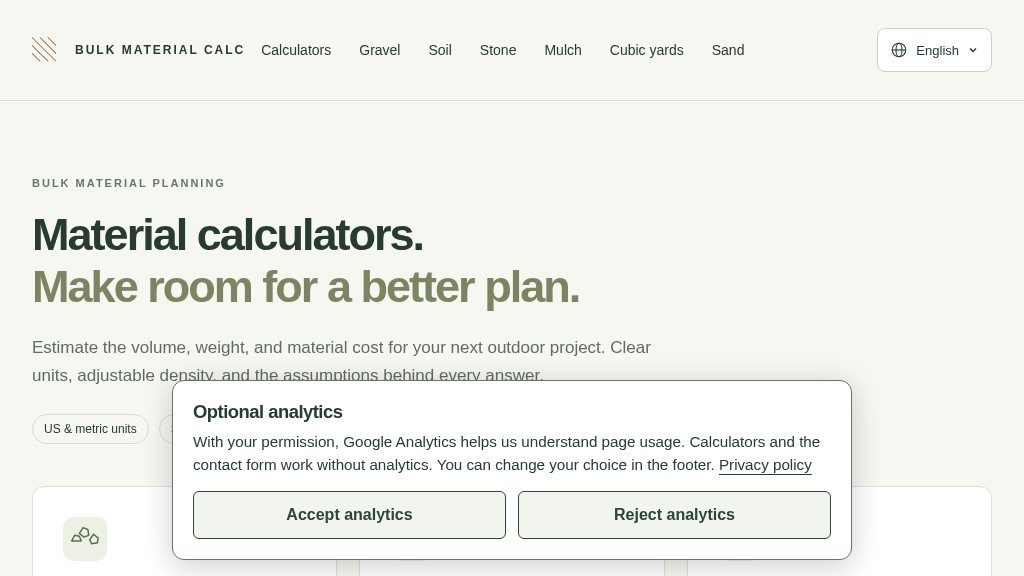
Website Overview
Planning an outdoor project often involves more than measuring length and width. Gravel, soil, mulch, sand, crushed stone, paver base, and similar materials are sold by different units, while density, compaction, bag sizes, and supplier pricing can change the final order. Bulk Material Calc is designed to organize those calculations in one browser-based resource, helping visitors turn project dimensions into estimated volume, weight, bag quantities, and—where supported—material cost.
The site covers common landscaping and construction materials, including gravel, topsoil and dirt, crushed stone, mulch, sand, rubber mulch, concrete, polymeric joint sand, and paver base. It also includes a general cubic yard calculator and a mass-and-volume converter for users who already know a material’s weight or volume.
Experience and Functionality
The calculators appear structured around practical project inputs rather than technical terminology alone. Users can work in US or metric units, enter dimensions and layer depths, and adjust supplier density when a more specific estimate is available. That matters because bulk density may vary with grading, moisture, and packing, so a generic result should be treated as an estimate rather than a supplier-certified quantity.
Several tools address details that are easy to overlook when ordering materials. The gravel, sand, and crushed stone calculators can present volume and weight, while the mulch calculator includes whole-bag comparisons. The paver-base tool separates aggregate base from bedding sand, and the polymeric joint sand calculator considers joint volume, bag quantities, coverage ranges, and cost. The concrete calculator covers slabs, footings, columns, and post holes, with options related to premixed bags or mixing components.
The page states that no signup is required, and its calculators are intended to work without enabling analytics. Visitors who allow Google Analytics can contribute usage data, while the page indicates that this choice can be changed in the footer.
Strengths
- Broad collection of calculators for landscaping, aggregate, sand, soil, mulch, concrete, and related materials
- Supports US and metric units with supplier-density adjustments for more tailored estimates
- Includes useful planning details such as whole bags, separate paver-base layers, compaction considerations, and cost comparisons
- No signup is stated as necessary, and the calculators are presented as usable without analytics
Cons
- Results remain estimates and depend on accurate measurements, appropriate layer depths, and reliable supplier density or coverage data
- Visitors must verify product-specific bag sizes, coverage ranges, minimum orders, and delivery costs with the supplier
Useful Scenarios
This collection may be useful when comparing a bulk supplier’s quote with bagged products, estimating a loose layer before accounting for compaction, or checking whether a project needs cubic yards, cubic feet, US short tons, metric tonnes, or bags. It can also provide a quick second calculation before contacting a supplier.
Who May Benefit
Homeowners, landscapers, DIY builders, and property managers may find the tools practical for early-stage planning. They are especially relevant for projects where material quantity and ordering units do not naturally match. Users should still confirm density, product coverage, bag size, minimum order quantities, and delivery charges with the supplier before placing an order.
Final Perspective
Bulk Material Calc is best understood as a planning and comparison aid rather than a replacement for site measurement or supplier specifications. A sensible next step is to measure the area carefully, choose the calculator that matches the material and application, enter supplier-specific density or pricing where available, and compare the resulting order with the seller’s quoted quantities and delivery terms.
Embeds
Copy short script widgets for this listing. People often use Textfrog to search for their next personal or work tool. Encourage your community to leave reviews on Textfrog.
Review widget
A clean review badge with stars and review count.
Featured badge
A compact badge for products listed on Textfrog.
Similar Tools
Compare business funding offers through one short request. with practical detail...

Free online ruler for on-screen measurement in centimeters, millimeters and inch...
Decks, dashboards, reports and invites are HTML now. with practical details for ...
Capital Gurus offers customized small business loans and financing solutions for...
Featured Links
Eduify is an online education platform that provides tools and resources for lea...
Setvo: your workouts, your progress, your space. with practical details for onli...