
Wire Fill Chart & Conduit Fill Calculator for NEC 2023
Business & Productivity ToolsDescription
Free NEC 2023 wire fill chart and conduit fill calculator. with practical details for online.
Why It Stands Out
Sizing conductors inside a raceway usually involves checking conduit dimensions, conductor areas, conductor counts, and the applicable NEC fill limits. Wire Fill Chart brings those steps into a browser-based workflow focused on NEC 2023 Chapter 9. It is designed for electricians, inspectors, and engineers who need to compare conduit types and wire combinations without manually searching across separate reference tables.
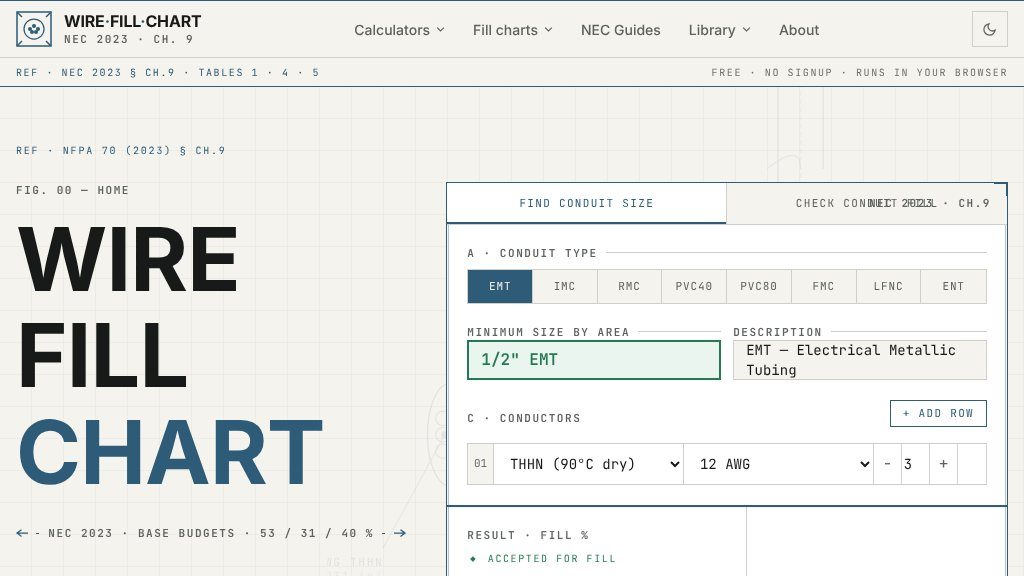
The calculator uses the site’s transcribed NEC Chapter 9 Tables 1, 4, and 5 data. It covers EMT, IMC, RMC, PVC 40, PVC 80, FMC, LFNC, and ENT, along with supported conductor markings such as THHN, THWN-2, RHH, RHW-2, and TW. The page also identifies the 53%, 31%, and 40% base fill budgets for one, two, and three or more conductors.
How It Can Be Used
A typical calculation starts by selecting a conduit type and trade size, then adding one or more conductor rows with insulation type, wire size, and quantity. Results show the calculated fill percentage, the applicable NEC status, conduit and wire areas, and whether the selected combination appears to exceed the supported fill limit. When a selection is overfilled, the interface can recommend the next trade size.
The tool also explains how its result is derived: conduit area comes from Table 4, conductor area comes from Table 5, and total fill is calculated from the combined conductor area divided by the conduit area. For supported equal-area conductors, it applies the site’s interpretation of NEC Table 1 Note 7. That makes it more useful than a simple percentage lookup when the allowable count does not align neatly with the base tier.
Strengths
- Interactive NEC 2023 Chapter 9 conduit-fill calculations across eight listed conduit types
- Shows fill percentage, NEC status, area calculations, and a geometric jamming-risk hint
- Supports multiple conductor markings, wire sizes, and mixed-area selections
- Includes related wire, box-fill, pull-box, conversion, bend, and voltage-drop calculators
Cons
- The tool does not assess ampacity, pulling feasibility, product suitability, or installation approval
- The geometric jamming indicator applies only to a narrow three-identical-conductor screening assumption
- Site-reported advertising and analytics scripts load across the website
Important Details and Trade-offs
The site includes printable and filterable chart references, direct-answer pages by conduit size, and additional calculators for wire size, AWG conversion, box fill, pull-box sizing, bend offsets, trade-size conversion, and voltage drop. It also lists NM-B, MC, and UF-B reference pages using the relevant Chapter 9 treatment described on the site.
However, the results are limited to the supported conductor and conduit data. The page explicitly states that fill calculations do not establish ampacity, product suitability, pulling feasibility, or installation approval. Its geometric jamming indicator is only a screening hint based on a specific three-identical-conductor assumption, not a complete pulling analysis. Visitors should also verify the transcribed NEC data and consult the governing code, adopted local requirements, and project-specific documentation before treating a result as an installation decision. Advertising and analytics scripts are reported as loading site-wide.
Possible Fit
This is a practical reference for professionals and learners who need quick NEC 2023 conduit-fill estimates, especially when comparing several raceway families or mixed conductor selections. It is less suitable as a standalone compliance tool because broader electrical design and inspection requirements remain outside its scope.
Evaluation Notes
The main value is the combination of interactive calculations, visible assumptions, and supporting chart pages. A sensible next step is to use it for preliminary sizing, then cross-check the result against the current applicable NEC edition, conductor specifications, and local approval requirements.
Embeds
Copy short script widgets for this listing. People often use Textfrog to search for their next personal or work tool. Encourage your community to leave reviews on Textfrog.
Review widget
A clean review badge with stars and review count.
Featured badge
A compact badge for products listed on Textfrog.
Similar Tools
Free calculators for gravel, soil, stone, mulch, sand, volume, paver base and po...
Compare business funding offers through one short request. with practical detail...

Free online ruler for on-screen measurement in centimeters, millimeters and inch...
Decks, dashboards, reports and invites are HTML now. with practical details for ...
Featured Links
Setvo: your workouts, your progress, your space. with practical details for onli...
Eduify is an online education platform that provides tools and resources for lea...