
ScrapeAtlas Review: Social Media Data API for Developers and AI Workflows
Developer & API ToolsDescription
Social media data API for public profiles, posts, videos and conversations. with practical details for.
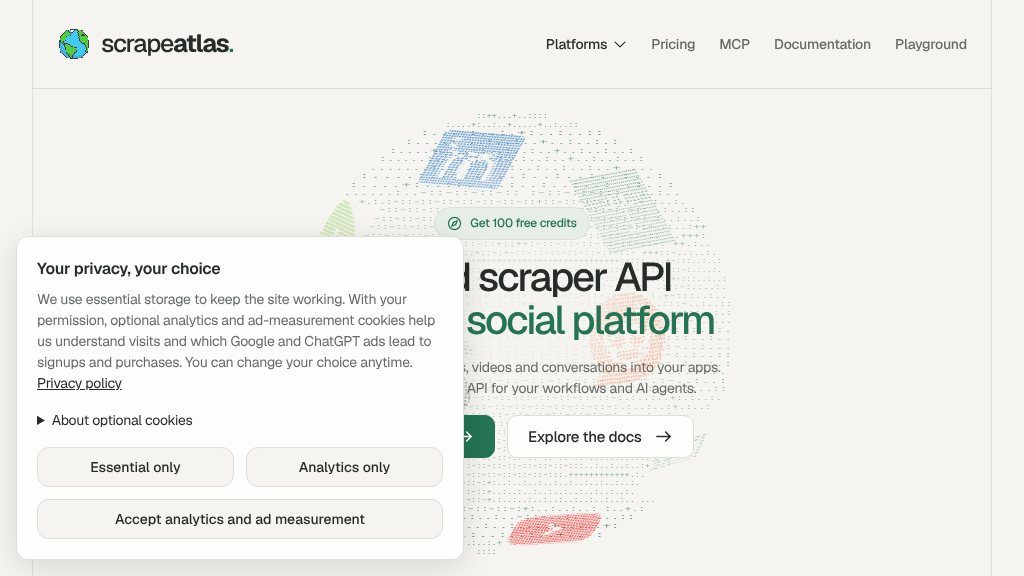
Where ScrapeAtlas Fits
ScrapeAtlas belongs to the Web Tools & SaaS category, specifically the Developer & API Tools subcategory. This part of the software landscape matters because developers often need to turn information from multiple public platforms into structured data without building and maintaining a separate connection for every source. ScrapeAtlas presents itself as a unified API for public social profiles, posts, videos, conversations, commerce data, and related online communities.
The site’s positioning is less about publishing content and more about supplying data for applications, research products, and automated workflows. Its examples show JavaScript requests made with an API key and returned JSON, giving prospective users a concrete view of how the service is intended to be used.
Why It Stands Out
The central proposition is one integration for several types of social and community data. The visible examples cover Instagram profiles, YouTube videos, and Depop shops. Returned fields include follower counts, media counts, video metadata, view totals, shop followers, items sold, and reviews. These snapshots suggest that the API is designed to make selected public information easier to consume in structured form.
The stated coverage extends beyond those examples to social networks, video platforms, forums, messaging, ad libraries, link-in-bio pages, commerce, prediction markets, and real-world events. Visitors should consult the documentation to confirm which platforms and endpoints are currently available, since the homepage alone does not provide a complete endpoint list.
Strengths
- Unified API concept for multiple social, video, community, and commerce data sources
- Concrete JavaScript and structured JSON examples for Instagram, YouTube, and Depop
- Use cases cover creator research, video intelligence, competitive analysis, commerce, and AI workflows
Cons
- The supplied page does not detail full pricing, quotas, rate limits, retention, or service-level commitments
- Platform coverage, freshness, and production reliability should be confirmed in the documentation before implementation
How It Can Be Used
Several practical use cases are presented:
- Creator discovery: compare public profiles, content, and engagement when building a campaign shortlist.
- Video intelligence: work with video metadata, transcripts, comments, and related context.
- Brand and competitive research: examine public posts, conversations, ads, creative approaches, and audience reactions.
- Commerce research: investigate products, sellers, prices, and reviews across supported marketplaces.
- AI workflows: provide public social context to agents through MCP or HTTP for research and summarization tasks.
These applications make the service potentially relevant to research tools, monitoring products, marketing software, and internal data workflows. The page also mentions a social media scheduler use case, although visitors should evaluate that workflow against their own platform and data requirements.
Important Details and Evaluation Notes
ScrapeAtlas displays an offer of 100 free credits and provides documentation-oriented examples, but the available material does not explain ongoing pricing, quotas, rate limits, retention, or service-level terms. Those details should be verified before implementation. It is also important to confirm data freshness, endpoint reliability, platform coverage, and whether a planned use complies with the applicable platform rules and privacy obligations.
Possible Fit
This service is worth investigating for developers who want a single API surface for public social and marketplace research. It may be less suitable for teams that need guaranteed coverage, detailed operational commitments, or information beyond what the supported public endpoints expose. Overall, the documentation and examples offer a useful starting point, but a careful review of endpoint availability, costs, and production conditions is advisable before committing to it.
Embeds
Copy short script widgets for this listing. People often use Textfrog to search for their next personal or work tool. Encourage your community to leave reviews on Textfrog.
Review widget
A clean review badge with stars and review count.
Featured badge
A compact badge for products listed on Textfrog.
Similar Tools
Encode, decode, and learn classical ciphers with free browser-based tools for Ca...
109 free online tools for PDF, image, video, text, finance & loans. with practic...
Compare two texts online and see every difference highlighted instantly. with pr...
Free online keyboard tester for Windows, Mac, and laptops. with practical detail...
Featured Links
Eduify is an online education platform that provides tools and resources for lea...
Setvo: your workouts, your progress, your space. with practical details for onli...